к учебнику 9 класса:


Victorian Social Classes
Quality of life during the Victorian era was very much dependant on social class. Very much as in Britain today the four main classes were the:-
- Upper class
- Middle class
- Working class, and
- Poor
The upper class was royalty, the aristocracy, and the very wealthy often from inherited wealth.
The Middle classes were the professionals including mill owners, doctors, scientists and trades persons.
The working class, often working 16 hours a day with no holidays worked in the mills, maids, servants, governesses and men and women doing all the menial tasks for the middle classes.
The poor included the unemployed and homeless and orphans.
As in today’s society, although it wasn't easy, it wasn’t impossible to move from one class status to another. An orphan could do an apprentice and learn a trade in a middle class professional, or alternatively a wealthy family could fall on hard times and end up becoming unemployed and homeless.

Maud Elizabeth Baglin 1885 nee Baldwi
Victorian Marriage and Married Life
Women were treated with respect and generally had equal rights and opportunities, with some notable exceptions e.g. no right to vote, although on the whole they were expected to marry, have children and look after the family home.
Two articles below, 'I am a Lawyer's Daughter' and 'Whom to Marry', published in Victorian newspaper gives some insight into this.

Managing Housewife

I am a Lawyer's Daughter

Whom to Marry
Children in the Victorian Family
Generally, children were considered 'Little Adults', who were given respect and who needed to be guided through lives perils by example and good sound advice. They were recognised as a future resource that required a lot of dedicated time and attention to help ensure their safe passage to adulthood. The above photo is of my grandmother with her siblings and parents; although my grandmother was born at the end of the Victorian era, the above photo (where she is the eldest child) was taken in the Edwardian period.
In Georgian times, and the early Victorian era, children from the working class families in particular, when old enough, were generally sent out to work e.g. in the coalmines and as chimney- sweeps, often as young as six, to bring much needed income into the family. However, with the dawning of the Victorian era came a recognition that children needed to be bought up in a safe family environment until they reached adulthood. Hence the birth of childhood as we know it today and the decline in child labour. Although for the poorer Victorian families who couldn't afford the cost of bringing up their children this enlightenment took many decades; so much so that even in the late Victorian period child chimney-sweeps and children working on the streets with their brushes as little sweepers earning tips from pedestrians for whom they cleared the paths; as depicted in the touching story 'Mother's Last Words' by Mary Sewell, born 1797.
28.04.26
Form 9 Unit 4 Passive voice Variant 1
1. Mum will send you the presents next week.
2. This old gentleman has sponsored this programme.
3. Alex has locked the door.
4. The children met the president.
5. The boy walks the dog twice a day.
6. We went to bed after Mum had switched off the lights.
7.Nikita Mikhalkov is directing an action film at the moment.
8.The local government have cut down three trees in our street.
9.The waiters serve lunch from 12 to 2.
10.When I got there, they were making the road.
11.The referee will stop the match if you abuse the players of another team..
12. Bob hasn’t washed his jeans since October.
Variant 2
1. Grandparents sent us the presents last month.
2. This old gentleman has already built a new house .
3. My Dad hasn’t opened the door yet.
4. The group of pilots will meet the president tomorrow.
5. The boy walked the dog twice a day.
6. We usually go to bed after Mum switches off the lights.
7.Nikita Mikhalkov directed an action film 2 years ago.
8.The local government are cutting down trees in our street now.
9.The waiters served lunch from 12 to 2 last year.
10.When I got there, they have already made the road.
11.The referee stopped the match when Arshavin abused the players of another team.
12. Bob hadn’t washed his jeans since October.


| 1-я форма | 2-я форма | 3-я форма | Перевод |
|---|---|---|---|
| rise | rose | risen | поднимать(ся) |
| wake | woke | woken | проснуться |
| be | was/were | been | быть |
| bear | bore | born(e) | носить, нести, родить, производить |
| beat | beat | beaten | бить |
| become | became | become | становиться |
| begin | began | begun | начинать |
| bend | bent | bent | гнуть |
| bet | bet | bet | делать ставку |
| bind | bound | bound | связывать |
| bite | bit | bitten | кусать |
| bleed | bled | bled | истекать кровью |
| blow | blew | blown | дуть |
| break | broke | broken | ломать |
| breed | bred | bred | разводить |
| bring | brought | brought | приносить |
| broadcast | broadcast | broadcast | вещать |
| build | built | built | строить |
| burn | burnt/burned | burnt/burned | жечь |
| burst | burst | burst | разрываться |
| buy | bought | bought | покупать |
| can | could | ... (been able) | модальный глагол, мочь |
| catch | caught | caught | ловить |
| choose | chose | chosen | выбирать |
| cling | clung | clung | цепляться |
| come | came | come | приходить |
| cost | cost | cost | стоить |
| creep | crept | crept | ползать, подкрадываться |
| cut | cut | cut | резать |
| deal | dealt | dealt | заключать сделку |
| dig | dug | dug | копать |
| do | did | done | делать |
| draw | drew | drawn | рисовать |
| dream | dreamt/dreamed | dreamt/dreamed | мечтать |
| drink | drank | drunk | пить |
| drive | drove | driven | водить (машину) |
| eat | ate | eaten | есть |
| fall | fell | fallen | падать |
| feed | fed | fed | кормить |
| feel | felt | felt | чувствовать |
| fight | fought | fought | драться |
| find | found | found | находить |
| fly | flew | flown | летать |
| forbid | forbade | forbidden | запрещать |
| forget | forgot | forgotten | забывать |
| forgive | forgave | forgiven | прощать |
| freeze | froze | frozen | замораживать |
| get | got | got | получать, брать |
| give | gave | given | отдавать |
| go | went | gone | идти |
| grind | ground | ground | молоть, смолоть |
| grow | grew | grown | растить |
| hang | hung | hung | развешивать, вешать |
| have | had | had | иметь |
| hear | heard | heard | слышать |
| hide | hid | hidden | прятать |
| hit | hit | hit | бить |
| hold | held | held | удерживать, захватывать |
| hurt | hurt | hurt | причинять боль |
| keep | kept | kept | хранить |
| kneel | knelt | knelt | становиться на колени |
| know | knew | known | знать |
| lay | laid | laid | класть |
| lead | led | led | вести |
| lean | leant/leaned | leant/leaned | прислонять |
| learn | learnt/learned | learnt/learned | учить |
| leave | left | left | покидать |
| lend | lent | lent | занимать |
| lie (in bed) | lay | lain | лежать |
| lie (to not tell the truth) | lied | lied | врать |
| light | lit/lighted | lit/lighted | подсвечивать, зажигать |
| lose | lost | lost | терять |
| make | made | made | делать |
| may | might | ... | модальный глагол, может быть |
| mean | meant | meant | иметь в виду |
| meet | met | met | встречать(ся) |
| mow | mowed | mown | скашивать, скосить |
| must | had to | ... | модальный глагол, должен |
| overtake | overtook | overtaken | обгонять |
| pay | paid | paid | платить |
| put | put | put | ставить |
| read | read | read | читать |
| ride | rode | ridden | кататься |
| ring | rang | rung | звонить |
| rise | rose | risen | подняться, воспрять |
| run | ran | run | бежать |
| saw | sawed | sawn/sawed | увидеть |
| say | said | said | говорить |
| see | saw | seen | видеть |
| sell | sold | sold | продавать |
| send | sent | sent | отправлять |
| set | set | set | ставить |
| sew | sewed | sewn/sewed | шить |
| shake | shook | shaken | встряхивать |
| shall | should | ... | модальный глагол, должен |
| shed | shed | shed | проливать (свет), сбросить (листву) |
| shine | shone | shone | сиять |
| shoot | shot | shot | стрелять |
| show | showed | shown | показывать |
| shrink | shrank | shrunk | сокращаться, отпрянуть, садиться (про одежду) |
| shut | shut | shut | закрывать |
| sing | sang | sung | петь |
| sink | sank | sunk | тонуть |
| sit | sat | sat | |
| sleep | slept | slept | спать |
| slide | slid | slid | скользить |
| smell | smelt | smelt | пахнуть |
| sow | sowed | sown/sowed | сеять, засеивать |
| speak | spoke | spoken | говорить |
| spell | spelt/spelled | spelt/spelled | произносить |
| spend | spent | spent | тратить |
| spill | spilt/spilled | spilt/spilled | проливать |
| spin | spun | spun | вращать(ся) |
| spit | spat | spat | плевать |
| spread | spread | spread | распространять, расстилать |
| stand | stood | stood | стоять |
| steal | stole | stolen | красть |
| stick | stuck | stuck | воткнуть, приклеить |
| sting | stung | stung | жалить, ужалить |
| stink | stank | stunk | вонять |
| strike | struck | struck | ударить, поразить |
| swear | swore | sworn | клясться |
| sweep | swept | swept | подметать |
| swell | swelled | swollen/swelled | раздувать, надувать |
| swim | swam | swum | плавать |
| swing | swung | swung | размахивать, поворачивать |
| take | took | taken | брать |
| teach | taught | taught | учить |
| tear | tore | torn | разрывать |
| tell | told | told | говорить, рассказывать |
| think | thought | thought | думать |
| throw | threw | thrown | бросать |
| understand | understood | understood | понимать |
| wake | woke | woken | будить |
| wear | wore | worn | носить |
| weep | wept | wept | плакать, рыдать |
| will | would | ... | модальный глагол будущего времени |
| win | won | won | побеждать |
| wind | wound | wound | укутывать, сматывать |
| write | wrote | written | писать |


A Local Sports Centre


Family
- How many members do you have in your family?
- Do you live with your parents or with your grandparents?
- Do you have any brothers/sisters?
- Are you the eldest among your brothers and sisters?
- Do you look like your mother or father?
- How often do you visit your relatives/grandparents?
- How many aunts and uncles do you have? Do you have any cousins?
- What are your parents like? What are their occupations?
- Do you get along well with your family/brothers or sisters?
- Do you think people should adopt children?
- What is the best memory you have with your parents/grandparents/brothers or sisters?
- What do your father and mother look like? If you have any siblings, can you describe them, too?
- Do you get along better with your mother or father? Why?
- Would you like to have any children in the future? Why/Why not?
- Do you think children should follow their parents’ dreams?
- Describe the importance of family in your country.
- Do you think children should help with the housework? Explain.
- What makes a good parent/life mate? Explain your opinions.
FAMILY MATTERS
What is Family?


What does the British Royal Family Do? (follow the link)
Task 3. You are going to give a talk about family. You will have to start in 1.5 minutes and speak for not more than 2 minutes (10–12 sentences).
Remember to say:
· why family plays an important role in every person’s life;
· what a typical Russian family is like;
· who you feel closest to in your family and why;
· what your attitude to having a big family is.
You have to talk continuously.
Дайте развернутый ответ.
You have received an email message from your English-speaking pen-friend Ann:
Write a message to Ann and answer her 3 questions.
Write 100–120 words. Remember the rules of email writing.
|
Task 2.1 You are going to read the text aloud. You have 1.5 minutes to read the text silently, and then be ready to read it aloud. Remember that you will not have more than 2 minutes for reading aloud.
We are always told that we should clean our teeth regularly to keep them healthy and to have fresh breath. It is believed that people started using a kind of paste to clean their teeth around 5000 years ago. However, the ingredients of these tooth powders were very different from ours. For example, the people of ancient Egypt used salt, mint, dried flowers and pepper to create tooth powder. Later, in the 18th century, in some countries in Europe, people brushed their teeth with burnt bread. The first toothpaste appeared in 1890, in Great Britain. At first it was sold in jars. Then special tubes were designed to make the toothpaste more comfortable to use.
Task 2.2 Task 1. You are going to read the text aloud. You have 1.5 minutes to read the text silently, and then be ready to read it aloud. Remember that you will not have more than 2 minutes for reading aloud.
The mobile phone has become an important part of our everyday life. We can’t imagine our lives without it now. Thanks to the mobile phone we can keep in contact with our relatives and friends at any time. We use them to text and to send emails, to share photos and videos. We can use the Internet and listen to music and do lots of other things. However, according to surveys, mobile phone users mostly spend their time on games and social networking. Around 80 percent of the world’s population has a mobile phone. The mobile phone industry is the fastest growing industry in the world. From 1983 to 2016, worldwide mobile phone subscriptions grew to over seven billion. |
Task 3.1. You are going to give a talk about conflicts with your friends. You will have to start in 1.5 minutes and speak for not more than 2 minutes (10–12 sentences).
Remember to say:
· why teenagers can have a conflict with their friends;
· what you usually have conflicts with your friends about;
· how you usually make up with your friends;
· what your attitude to conflicts with your friends is.
You have to talk continuously.
Task 3.2. You are going to give a talk about your friends. You will have to start in 1.5 minutes and speak for not more than 2 minutes (10–12 sentences).
Remember to say:
· how many friends you have and if they are mostly boys or girls or both;
· what you like about them;
· if there is anything in their behaviour that annoys you;
· what brings you together and makes you good friends:
· what your attitude to conflicts with your friends is.
You have to talk continuously.
At home:
Exercise 3: Fill in negative prefixes to form the OPPOSITE of each of the adjectives below. In some cases, more than one pre-fix is possible.
___acceptable ___accurate ___adequate ___agreeable ___approachable ___appropriate ___bearable ___compatible ___complete ___conscious ___contented ___convenient ___credible ___decisive ___desirable ___discreet ___excusable ___experienced ___faithful ___flexible ___frequent ___grateful ___healthy ___helpful ___hospitable ___legal ___legible ___legitimate ___literate ___logical ___mature ___moral ___mortal ___obedient ___organised ___passive ___patient ___perfect ___personal ___polite ___probable ___readable ___regular ___resolute ___responsible ___respectful ___sane ___satisfactory ___satisfied ___sociable ___sufficient ___variable ___visible ___willing
Exercise 4: Complete the sentences by adding the correct pre-fix for each word.
1 It's rather ___polite if you don't say 'Please' a lot in English. 2 My parents are extremely generous with their time and money. They are very ___selfish. 3 If the traffic is bad, it'll be ___possible to get to the match on time. 4 It's ___legal to drive along that street; it's for pedestrians only. 5 My mum thought a burglar had been in my bedroom, but it's always really ___tidy. 6 It was completely ___responsible of you to go away for the weekend without telling us. 7 Mike's pretty ___happy about going on holiday with his girlfriend's parents. 8 I never know when to expect the post. It's so ___regular. 9 Taking a large suitcase on a waling holiday is a bit ___practical.
👇 Recollect the structure
To write a personal letter
👉Follow the example:
Dear Alice,
Thank you for your email. I'm glad to hear from you again.
In your email you ask me about ... (subject). Well, ... (ответы на 3 вопроса).
That's all for now. Keep in touch.
Love,
Ann
Exercise 1 Write the negative form of these words by adding a negative prefix: "un-", "dis-", "ir-", "il-", "in-", or "im-".
1 ____comfortable 2 ____patient 3 ____honest 4 ____ lucky 5 ____formal 6 ____possible 7 ____popular 8 ____lock 9 ____appear 10 ____agree 11 ____legal 12 ____polite 13 ____like 14 ____logical 15 ____convenient
Exercise 2: Write the negative form of these words by adding a negative prefix: "un-", "dis-", "ir-", "il-", "in-", or "im-".
1 ____frequent 6 ____believable 11 ____relevant 2 ____mature 7 ____approve 12 ____dependent 3 ____legible 8 ____curable 13 ____responsible 4 ____moral 9 ____familiar 14 ____accurate 5 ____regular 10 ____grateful 15 ____resistible
Task 2. You are going to read the text aloud. You have 1.5 minutes to read the text silently, and then be ready to read it aloud. Remember that you will not have more than 2 minutes for reading aloud.
We are always told that we should clean our teeth regularly to keep them healthy and to have fresh breath. It is believed that people started using a kind of paste to clean their teeth around 5000 years ago. However, the ingredients of these tooth powders were very different from ours. For example, the people of ancient Egypt used salt, mint, dried flowers and pepper to create tooth powder. Later, in the 18th century, in some countries in Europe, people brushed their teeth with burnt bread. The first toothpaste appeared in 1890, in Great Britain. At first it was sold in jars. Then special tubes were designed to make the toothpaste more comfortable to use.
Task 3. You are going to give a talk about conflicts with your friends. You will have to start in 1.5 minutes and speak for not more than 2 minutes (10–12 sentences).
Remember to say:
· why teenagers can have a conflict with their friends;
· what you usually have conflicts with your friends about;
· how you usually make up with your friends;
· what your attitude to conflicts with your friends is.
You have to talk continuously.
Фразы для повторения и перевода:
1.Пройти этот этап
2.Дерзкий
3.Неуклюжий (2)
4.Нетерпимый
5.Неудачник
6.Ладить со взрослыми и сверстниками
7.Высокая самооценка
8.Пренебрегать школьными занятиями
9.Идти навстречу друг другу, идти на компромисс
10.Наружность, внешний вид (2)
11.Стать фанатом спортивной команды
12.Разрушать здоровье
13.Устанавливать хорошие отношения
14.Найти друзей на всю жизнь
Обращаться с кем-либо как с ребенком
Агрессивный
Негибкий
Отверженный
Преодолевать комплексы
Низкая самооценка
Пренебрегать домашним заданием
Стать зависимым от интернета
Пасть жертвой преступления
Поддерживать хорошие отношения
Развивать позитивное отношение к людям

2. You are going to give a talk about youth movements.
3. You are going to give a talk about youth movements.
Упр. 1. Раскройте скобки, употребляя глаголы в Present Perfect или Past Simple.
1. We (to travel) around Europe last year. 2. My father knows so much because he (to travel) a lot. 3.1 (to see) Pete today, 4. She (to see) this film last Sunday. 5. Alex (to meet) his friend two hours ago. 6.1 just (to meet) our teacher. 7. The children already (to decide) what to do with the books. 8. Yesterday they (to decide) to help their grandmother. 9. Helen speaks French so well because she (to live) in France. 10. She (to live) there last year. 11. The rain (to stop) and the sun is shining in the sky again. 12. The rain (to stop) half an hour ago. 13. Mary (to buy) a new hat. 14.1 (to buy) a pair of gloves yesterday. 15. The wind (to blow) off the man's hat, and he cannot catch it. 16. The weather (to change), and we can go for a walk. 17. The wind (to change) in the morning.
Упр. 2. Раскройте скобки, употребляя глаголы в Present Perfect или Past Simple.
1. I already (to do) my homework. Now I can go for a walk. 2. I (to do) my homework yesterday. 3. He just (to come) home. 4. He (to come) home a minute ago. 5. Nick (to play) football yesterday. 6. She already (to come) from school. Now she is doing her homework. 7. I (to read) this book last year. 8. I (to read) this book this year. 9.1 never (to be) to Washington. 10. You ever (to be) to New York? 11. You ever (to see) the eruption of a volcano? 12. I (not yet to eat) today. 13. He (not to eat) yesterday. 14. You (to play) the piano yesterday? 15. You (to play) the piano today? 16. What you (to prepare) for today? 17. Look at this bird-house. Mike (to make) it himself. He (to make) it last Sunday. 18. Where you (to put) my pen? I cannot find it. 19. You (to see) Mary today? 20. When you (to see) Mary? — I (to see) her last week. 21. Your mother (to promise) to take you to the theatre? 22. Look at my new dress! I (to make) it myself. 23. He is not at school today, he (to fall) ill. — When he (to fall) ill? — He (to fall) ill yesterday.
Упр. 3. Раскройте скобки, употребляя глаголы в Past Simple или Past Perfect.
1. When I (to come) home, mother already (to cook) dinner. 2. When father (to return) from work, we already (to do) our homework. 3. When the teacher (to enter) the classroom, the pupils already (to open) their books. 4. Kate (to give) me the book which she (to buy) the day before. 5. Nick (to show) the teacher the picture which he (to draw). 6. The boy (to give) the goats the grass which he (to bring) from the field. 7. Mother (to see) that Nick (not to wash) his hands. 8. The teacher (to understand) that Lena (not to do) her homework. 9. I (to know) that my friend (not yet to come). 10. Tom (to return) from the cinema at five o'clock. 11. Tom (to return) from the cinema by five o'clock. 12. I (to finish) my homework at seven o'clock. 13. I (to finish) my homework by seven o'clock. 14. He (to think) that he (to lose) the money. 15. Ann (to tell) me that she (to see) an interesting film. 16. When I (to wake) up yesterday, father already (to go) to work. 17. Nick (to think) that his father (not yet to come) home. 18. Mary (to tell) us that she (to cook) a good dinner. 19. Yesterday I (to find) the book which I (to lose) in summer. 20. When we (to come) to the station, the train already (to leave).
Упр. 4. Раскройте скобки, употребляя глаголы в Past Simple или Past Perfect.
1. Не(to study) French before he (to enter) the university. 2. Lanny (to say) that he (to get) his education in Cape Town. 3. The boy (to want) to act the main part in the play because he (to organize) the theatre. 4. Lanny (not to know) who (to attack) him in the darkness. 5. The girl (to be) glad that she (to find) a seat near the window. 6. Suddenly he (to remember) that he (not to ring) her up in the morning. 7. By the time the train (to reach) the city, he (to make) friends with many passengers. 8. When his uncle (to leave), he (to hurry) to the station to book a ticket. 9. She (to think) that Gert and Lanny (to quarrel). 10. By the time we (to come) to see him, he (to return) home. 11. During the holidays my friend (to visit) the village where he (to live) in his childhood. 12. When they (to enter) the hall, the performance already (to begin). 13. When I came home, my mother (to tell) me that she (to receive) a letter from grandfather. 14. Where you (to work) before you (to enter) the institute? 15. By two o'clock the teacher (to examine) all the students. 16. On my way to school I (to remember) that I (to leave) my report at home. 17. All my friends (to be) glad to hear that I (to pass) all the examinations successfully. 18. Poor Oliver (to lie) unconscious on the spot where Sikes (to leave) him. 19. He (to open) his eyes, (to look) around and (to try) to remember what (to happen) to him. 20. All the passengers (to see) at once that the old man (to travel) a great deal in his life.
Упр. 5. Раскройте скобки, употребляя глаголы в
- I (to be) there on time tomorrow
- He said that he (not to come) to school the next day
- You (to invite) to the club by your friends?
- She (to go) to the grocery store tomorrow
- They said that the car (to fix) soon
- [из прошлого] He (to help) her?
- We (to be) friends forever!
- I (not to teach) by her
- Did she say that she (to pass) the exam?
- He (to pick) her up at 10 am
- She told him she (not to cook) anything
- He (to greet) by everyone?
- They said they (to meet) in the park
- The furniture (not to buy) by them.
At home:
Task 1 You are going to give a talk about friends. You will have to start in 1,5 minutes and speak for not more than 2 minutes (10-12 sentences). Remember to say:
— A friend in need is a friend indeed. Why it is important to have friends;
— If you have a lot of true friends; what a good friend should be like;— What is more attractive - to have one close friend or a group of friends;
— How much time you spend together.
You have to talk continuously.Task 2 Ex 10 p 130 (114) words and phrases learn for dictation (учим английскую фразу и русский эквивалент, если глагол - знать форму прошлого)
— A friend in need is a friend indeed. Why it is important to have friends;
— If you have a lot of true friends; what a good friend should be like;
— How much time you spend together.
23.01.26Sports and games in teenager's life (Unit 3)

Sports (follow the link)
You have 30 minutes to do this task.
FROM:Dan
TO: Russian Friend
SUBJECT: Sports
You have received a letter from your English-speaking pen friend, Dan, who writes ...
I’ve decided to do some sports to feel better and to be fitter, But I don’t know what to choose. many of my friends choose extreme sports …
... What kinds of sports are popular with teenagers in Russia and what do you do to keep fit? What sports facilities do you have in your school? Would you like to try any extreme sport, why or why not?
Write a message to Ben and answer his 3 questions.
Write 100–120 words.
Remember the rules of email writing.
21.01.26English (practice)At home:
You are going to give a talk about hobbies. You will have to start in 1,5 minutes and speak for not more than 2 minutes (10-12 sentences). Remember to say:
— Tastes differ. How people choose their hobbies;
— What hobbies modern teenagers usually take up;
— How you usually spend your leisure time;
— How your hobby can help you to learn new things.
You have to talk continuously.
19.01.26At the lesson - follow the link https://edu.skysmart.ru/student/hasemaxefi and do the task
(H/T)Task 1 Speak about school uniform:Task 3
You will give a talk about school uniform. You will have to start in 1.5 minutes and speak for not more than 2 minutes (10-12 sentences).
Remember to say:
- whether it is important to wear uniform at school, and why
- what clothes you wear to school
- what you like most about your school
- what your attitude to your school uniform is
You have to talk continuously.
Task 2 Give the answers to the interview, write them down and learn:
— Tastes differ. How people choose their hobbies;
— What hobbies modern teenagers usually take up;
— How you usually spend your leisure time;
— How your hobby can help you to learn new things.
Task 3
You will give a talk about school uniform. You will have to start in 1.5 minutes and speak for not more than 2 minutes (10-12 sentences).
Remember to say:
- whether it is important to wear uniform at school, and why
- what clothes you wear to school
- what you like most about your school
- what your attitude to your school uniform is
You have to talk continuously.
16.01.26Stressed out
At home: Write a letter (100-120 words)
You have 30 minutes to do this task.
At home: Write a letter (100-120 words)
You have 30 minutes to do this task.
FROM: AlexTO: Russian FriendSUBJECT: StressYou have received a letter from your English-speaking pen friend, Alex.…we have too many tests and too much stress every school day …Do you have a lot of tests at school? Are tests useful, why or why not? What can stress you out? What do you do to reduce stress? Write a message to Ben and answer his 4questions.
Write 100–120 words.
Remember the rules of email writing.
Write 100–120 words.
Remember the rules of email writing.
👉Follow the example:
Dear Alice,
Thank you for your email. I'm glad to hear from you again.
In your email you ask me about ... (subject). Well, ... (ответы на 3 вопроса).
That's all for now. Keep in touch.
Love,
Ann
Listening "School uniform"

 Which are PROS and CONS?
Вы услышите пять высказываний, обозначенных буквами А, В, С, D, Е. Установите соответствие между высказываниями и утверждениями из следующего списка: к каждому высказыванию подберите соответствующее утверждение, обозначенное цифрами. Используйте каждое утверждение из списка 1 — 6 только один раз. В задании есть одно лишнее утверждение. Прослушайте запись дважды. (follow the link)
1. The speaker talks about the disadvantages of school uniform.
2. The speaker talks about practical clothes for different activities.
3. The speaker talks about uniforms worn by people of different professions.
4. The speaker talks about uniforms for professional sportsmen.
5. The speaker talks about the advantages of school uniform.
6. The speaker talks about his/her shopping experience.
Говорящий A B C D E Утверждение
👉Follow the example:
Dear Alice,
Thank you for your email. I'm glad to hear from you again.
In your email you ask me about ... (subject). Well, ... (ответы на 3 вопроса).
That's all for now. Keep in touch.
Love,
Ann
Вы услышите пять высказываний, обозначенных буквами А, В, С, D, Е. Установите соответствие между высказываниями и утверждениями из следующего списка: к каждому высказыванию подберите соответствующее утверждение, обозначенное цифрами. Используйте каждое утверждение из списка 1 — 6 только один раз. В задании есть одно лишнее утверждение. Прослушайте запись дважды. (follow the link)
1. The speaker talks about the disadvantages of school uniform.
2. The speaker talks about practical clothes for different activities.
3. The speaker talks about uniforms worn by people of different professions.
4. The speaker talks about uniforms for professional sportsmen.
5. The speaker talks about the advantages of school uniform.
6. The speaker talks about his/her shopping experience.
| Говорящий | A | B | C | D | E |
| Утверждение |
Complete the sentences and speak about Youth organizations in the UK (See AB ex 3 p 44):1. Youth movements have become ... .2. There are about ... in Great Britain.3. All youth organizations can be divided ... .4. The two largest non-political youth organizations are ... .They were founded in ... and ... by ... .5. Boys are trained in ... (5). The training of girls is planned to develop ... (2). They have special uniforms and ... .6. There are some other non-political organizations such as ... .7. Greenpeace deals with ... . The most serious environmental problems are * ... (name 3), It protests against ... .8. All these organizations aim at ... .9. In Russia there are many non-political youth organizations. Some of them are ... . They aim at ... .* Environmental problems:- pollution in its many forms (air, water, noise, nuclear, soil);- deforestation;- growth of population.


You have received an email message from your English-speaking pen-friend Andrew:
From: Andrew@mail.uk
To: Russian_friend@oge.ru
Subject: School
… We have lots of optional courses at school but I spend so much time on my main subjects that I have no time for anything else.
… What school subject do you find the most difficult and why?How many lessons do you usually have a day? How much time do you need to do your homework? How do you spend your time after classes?…
Write a message to Andrew and answer his 4 questions.
Write 100–120 words.
Remember the rules of email writing.
14.01.26Answer the questions of the interview:1. How much pocket money do you get? What do you spend your pocket money on?2. What time do you have to be at home in the evening?3. What do you do in your free time?4. Do you have to wear a uniform at school?5. How much homework do you have?6. Do you enjoy school? Why or why not?7. What do you like/hate about being a teen?8. Do you feel safe in your city?9. Is there anything you can't live without?10 . Who is your role model/hero?
25.12.25
24/12/25
At home:
Task 1. Дайте развернутый ответ.
You have to talk continuously.
👉👉👉 Begin with - "I'm going to give a talk about ... "
Finish with - "That's all I wanted to say about ... "
Task 2 Write a letter (100-120 words)
You have 30 minutes to do this task.
You have received an email message from your English-speaking pen-friend Andrew:
From: Andrew@mail.uk |
To: Russian_friend@oge.ru |
Subject: School |
… We have lots of optional courses at school but I spend so much time on my main subjects that I have no time for anything else. … What school subject do you find the most difficult and why?How many lessons do you usually have a day? How much time do you need to do your homework? How do you spend your time after classes?… |
Write a message to Andrew and answer his 4 questions.
Write 100–120 words.
Remember the rules of email writing.
At home:
You have to talk continuously.
👉👉👉 Begin with - "I'm going to give a talk about ... "
Finish with - "That's all I wanted to say about ... "
Task 2 Write a letter (100-120 words)
You have 30 minutes to do this task.
FROM: AlexTO: Russian FriendSUBJECT: Mass mediaYou have received a letter from your English-speaking pen friend, Alex.…one day I will be a reporter and write really good news.…How do you get to know what's happening in the world? What kind of information most papers and magazines have? What kind of mass media modern teenagers enjoy reading? What kind of mass media you prefer?
Write a message to Ben and answer his 3 questions.
Write 100–120 words.
Remember the rules of email writing.
👉Follow the example:
Dear Alice,
Thank you for your email. I'm glad to hear from you again.
In your email you ask me about ... (subject). Well, ... (ответы на 3 вопроса).
That's all for now. Keep in touch.
Love,
Ann

Write a message to Ben and answer his 3 questions.
Write 100–120 words.
Remember the rules of email writing.
👉Follow the example:
Dear Alice,
Thank you for your email. I'm glad to hear from you again.
In your email you ask me about ... (subject). Well, ... (ответы на 3 вопроса).
That's all for now. Keep in touch.
Love,
Ann
Topical vocabulary oral test (see p 100-101 ) + ex 43, 44, 45 p 90 (102):Form 9 Unit 2 Give English equivalents to the following phrases:
1. Подписывать международные договоры.
2. Объединять усилия с другими странами.
3. Проводить международные встречи, конференции, саммиты, переговоры.
4. Запретить и постепенно уничтожить оружие массового поражения.
5. Урегулировать локальные конфликты.
6. Восстанавливать мир в очагах напряженности.
7. Не использовать силу в международных отношениях.
8. Бороться против терроризма.
9. спасать будущие поколения от ужасов войны.
10. Обеспечивать права.
11. Осуществлять права.
12. соблюдать права.
13. нарушать права (2).
14. Человеческое отношение к гражданским лицам в военное время.
15. Защита раненых солдат.
16. Справедливое обращение с военнопленными, беженцами и заключенными.
12/12/25The Cold War was a long period of tension and rivalry between the United States and its friends, and the Soviet Union (also known as the USSR) and its friends. It lasted from the end of World War II until the Soviet Union broke apart. It was called "Cold" because the US and the USSR never fought each other directly. Instead, they supported different sides in smaller wars around the world, called proxy wars.
Form 9 Unit 2 Give English equivalents to the following phrases:
1. Подписывать международные договоры.
2. Объединять усилия с другими странами.
3. Проводить международные встречи, конференции, саммиты, переговоры.
4. Запретить и постепенно уничтожить оружие массового поражения.
5. Урегулировать локальные конфликты.
6. Восстанавливать мир в очагах напряженности.
7. Не использовать силу в международных отношениях.
8. Бороться против терроризма.
9. спасать будущие поколения от ужасов войны.
10. Обеспечивать права.
11. Осуществлять права.
12. соблюдать права.
13. нарушать права (2).
14. Человеческое отношение к гражданским лицам в военное время.
15. Защита раненых солдат.
16. Справедливое обращение с военнопленными, беженцами и заключенными.
Two Sides: East and West
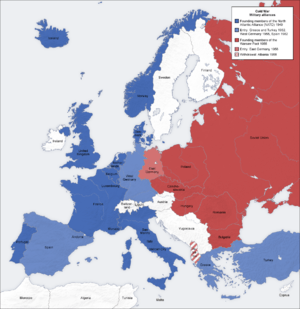 NATO states (blue) and Warsaw Pact states (red)
During the Cold War, the world was largely divided into two main groups. On one side was the Western Bloc, led by the United States. This group believed in capitalism and democracy. Many of these countries joined an alliance called NATO (North Atlantic Treaty Organization) in 1949. Important members included the US, United Kingdom, France, West Germany, and Canada. Other friends of the Western Bloc were Japan, South Korea, Australia, and New Zealand.
On the other side was the Eastern Bloc, led by the Soviet Union (USSR). This group believed in communism. Many of these countries formed an alliance called the Warsaw Pact in 1955. Key members included the USSR, East Germany, Poland, and Hungary. Other allies of the Eastern Bloc included Cuba, North Korea, and Vietnam.

10/12/25


During the Cold War, the world was largely divided into two main groups. On one side was the Western Bloc, led by the United States. This group believed in capitalism and democracy. Many of these countries joined an alliance called NATO (North Atlantic Treaty Organization) in 1949. Important members included the US, United Kingdom, France, West Germany, and Canada. Other friends of the Western Bloc were Japan, South Korea, Australia, and New Zealand.
On the other side was the Eastern Bloc, led by the Soviet Union (USSR). This group believed in communism. Many of these countries formed an alliance called the Warsaw Pact in 1955. Key members included the USSR, East Germany, Poland, and Hungary. Other allies of the Eastern Bloc included Cuba, North Korea, and Vietnam.
Politics
Точное значение politics – политика. Именно в этом контексте слово употребляется всегда. Его применяют для разговоров об управлении государством. Несмотря на окончание -s, существительное в единственном числе и употребляется с соответственной формой глагола.
Примеры употребления:
I plan to make a career in politics. Я планирую делать карьеру в политике.
He thinks he is an expert at politics. Он думает, что является экспертом в политике.
Policy
Слово часто переводится на русский язык как «политика», но оно означает план действий, некие правила и традиции в определенной сфере. Например, слово policy может применяться в контексте «политика компании», это означает свод правил, которых придерживается организация.
Примеры употребления:
The bank’s policy is not to open personal information about clients. Политика банка запрещает раскрывать персональные данные клиентов.
I do not agree with company’s policy. Я не согласен с политикой (правилами) компании.

В английском языке есть несколько слов, которые часто вызывают путаницу из-за схожих значений. Некоторые из них — join, unite, pool и combine. Все эти глаголы в той или иной степени означают "объединять", но каждый из них имеет свою уникальную нюансировку и использование в контексте. Давайте подробнее разберёмся, в чем их отличия и как правильно их использовать.
1. Join (присоединяться)
Join используется, когда кто-то становится частью группы, организации или мероприятия. Этот глагол часто подразумевает активное участие или вхождение в состав чего-то существующего. Например, когда кто-то присоединяется к команде, клубу или мероприятию, он становится частью уже существующей структуры или группы.
- Пример: "He joined the chess club last week" (Он присоединился к шахматному клубу на прошлой неделе).
- Пример: "Would you like to join us for dinner?" (Ты хочешь присоединиться к нам на ужин?)
В этом случае слово join подразумевает присоединение к уже существующему коллективу или деятельности.
2. Unite (объединяться)
Unite означает объединение нескольких людей, групп или организаций ради достижения общей цели или противостояния общей проблеме. Этот глагол часто имеет эмоциональную или идеологическую окраску и указывает на более тесное и целенаправленное объединение.
- Пример: "The community united to support the local school" (Сообщество объединилось, чтобы поддержать местную школу).
- Пример: "They united their efforts to save the endangered species" (Они объединили свои усилия, чтобы спасти исчезающий вид).
Unite часто используется, когда речь идет о более глубоком уровне взаимодействия и сотрудничества, где важна общая цель или ценности.
3. Pool (объединять)
Pool относится к объединению ресурсов или усилий для их более эффективного использования. Этот глагол часто используется в контексте совместных действий, где ресурсы нескольких сторон объединяются для достижения общей выгоды или цели.
- Пример: "The neighbors pooled their resources to build a new playground" (Соседи объединили свои ресурсы, чтобы построить новую детскую площадку).
- Пример: "Scientists pooled their knowledge to solve the complex problem" (Ученые объединили свои знания, чтобы решить сложную проблему).
Когда используется pool, акцент делается на совместном использовании ресурсов, будь то деньги, знания или усилия, чтобы добиться большего эффекта.
4. Combine (комбинировать)
Combine означает смешивание или объединение нескольких элементов для создания чего-то нового. Этот глагол часто используется, когда речь идет о создании нового целого из отдельных частей, будь то ингредиенты в рецепте, идеи в проекте или технологии в изобретении.
- Пример: "She combined two ingredients to make a new sauce" (Она скомбинировала два ингредиента, чтобы сделать новый соус).
- Пример: "The company combined traditional methods with modern technology to create a unique product" (Компания объединила традиционные методы с современными технологиями для создания уникального продукта).
Слово combine акцентирует внимание на процессе соединения разных частей для формирования нового целого.

ECONOMIC
прилагательное со значением «имеющий отношение к экономике», то есть экономический
The economic growth is very slow. — экономический рост очень медленный.
ECONOMICAL
прилагательное имеет значение «экономный, экономичный», то есть такой, который не требует большого количества каких-либо ресурсов для нормального функционирования
That placement of furniture exhibits a very economical use of space. — Такое размещение мебели демонстрирует очень экономичное использование пространства.

UTOPIA (by T. MORE)
👉👉👉Can a Utopian Society exist? Will you be able to answer this question?


Form 9 Unit 1 Lexical test (topical vocabulary)
Translate and do ex 23, 24 in writing:
Объявить войну стране 2. Нести тяжелые потери 3. Осадить город 4. Отразить атаки врага 5. Стать беженцем (военнопленным, заложниками) 6. Штаб 7. Закончиться победой (поражением) после тяжелых боев 8. Захватить территорию врага 9. Вести военные действия 10. Освободить пленных 11. Взять трех офицеров в плен 12. Развязать войну 13. Вести военные действия 14. Атаковать вражеские войска 15. Нести большие потери 16. Средства ведения современных военных действий 17. Стоить жизни многих людей 18. Пасть на поле сражения 19. Вступить в армию 20. Отступать или контратаковать.


cactus-cacti


swine-swine [swain]


Complete the sentences to make up a story:


Task 3


Ex. 1 Articles: Exercises for Advanced Students
- I have uncle who lives in home for elderly. He is honest man. He used to be FBI agent. He once saved one-year-old boy from fire. He has many interesting stories.
- He told me that he once met alien from space. This alien didn't need oxygen to live; it didn't have nose. That's hard story to believe. I'm not sure he was telling me truth. Maybe he isn't so honest, after all.
- can make life unpleasant. In day, I work at office. people I work with are busy, and work we do isn't easy.
Ex. 2 Articles: More Exercises for Advanced Students
- When I drive to work, usually highways are really busy. If there's accident during rush hour, it can be chaos on the roads.
- I don't watch TV. I get information and news, etc., from Internet. I don't often go to cinema, either.
- I'm interested in finance. I heard Euro is losing value, compared to US dollar.
- I like Japan. is infrequent there. When I fly to Japan, I usually fly to Narita Airport. The last time I was in Japan, I climbed Mount Fuji. It was fun.
- I am tall. are generally shorter than I am.
- Moving to United States was most exciting thing I have ever done. I moved last year to New York. New York is exciting city, full of adventure. In fact, I saw famous actor on street yesterday!
- Today, I have job interview at financial company. has offices all over world. I'm not sure that I have skills to get hired. I hope so. 's office is on Main Street. That's same street my friend works on.
- If I get hired, I could meet him after work for drinks. That would be great. He's from Scotland. He works 8 hours day, 5 days week.
 |


Articles: Exercises for Intermediate Students
- Moving to United States was most exciting thing I have ever done. I moved last year to New York. New York is exciting city, full of adventure. In fact, I saw famous actor on street yesterday!
- Today, I have job interview at financial company. has offices all over world. I'm not sure that I have skills to get hired. I hope so. 's office is on Main Street. That's same street my friend works on.
- If I get hired, I could meet him after work for drinks. That would be great. He's from Scotland. He works 8 hours day, 5 days week.
Articles: More Exercises for Intermediate Students
- I have two brothers. One, Greg, is still in college, and other, Mike, has already graduated. Mike is kind of guy that is very serious. I don't remember last time I saw him. It may have been in August. He was wearing red sweater. It matched his red hair.
- After dinner, I usually wash dishes. My wife hates doing it. I waste a lot of water when I do it. That's bad for environment, I think.
- We live near sea. houses in this area are expensive.

Complete the sentences:
Упражнение 1. Раскройте скобки, употребляя глаголы в Present Continuous или в Present Simple.
I (not to know) what to give my brother for his birthday.
They (to want) to publish this book in July?
He (to understand) that he (to eat) noisily, but he always (to forget) about it.
Now I (to hate) him more than ever.
You (to want) to see my father? — Yes, I (to need) him at the moment very much.
He (to learn) English because he (to want) to get a better job.
She (to want) to impress everybody.
Listen to Greg! You (to understand) what language he (speak)?
I (not to like) to watch TV very often. But at the moment I (to enjoy) my favourite film.

Упражнение 3. Раскройте скобки, употребляя глаголы в Present Continuous или в Present Simple.


Глаголы, не имеющие форм Continuous.
Verbs not used with Continuous Tenses
В английском языке существуют глаголы, которые не употребляются во временах Continuous, они употребляются только во временных формах Simple.
Глаголы эмоционального состояния
to wish – желать
to desire – желать
to want – хотеть
to envy – завидовать
to hate – ненавидеть
to like – нравиться
to love – любить
to prefer – предпочитать
to fear – бояться
to need – нуждаться
to satisfy – удовлетворять
to seem – казаться
Глаголы мыслительной деятельности
to believe – верить
to deny – отрицать
to doubt – сомневаться
to expect – полагать
to forget – забывать
to know – знать
to recognize – узнавать
to remember – помнить
to respect – уважать
to suppose – предполагать
to think* – считать, полагать
to understand – понимать
Глаголы ощущения
to hear* – слышать
to see* – видеть
to taste* – иметь вкус
to smell* – пахнуть
to feel* – ощущать
Глаголы обладания, отношения
to be* – быть
to consist – состоять
to belong – принадлежать
to contain – содержать
to have* – иметь
to include – заключать в себе
to possess – обладать
to own – владеть
Внимание! Глаголы отмеченные * могут употребляться в форме Continuous, но только с изменением значения. Они выражают не состояние, а действие. Сравните следующие примеры глаголов:
Глаголы употребленные в форме Simple | Глаголы употребленные в форме Continuous |
to think – считать, полагать | to think – думать, размышлять |
to hear – слышать | to hear = to listen to – слушать, выслушивать |
to see – видеть | to see = to look at – смотреть, встречаться |
to taste – иметь вкус | to taste – пробовать на вкус |
to smell – пахнуть | to smell = to sniff– нюхать |
to feel-ощущать | to feel – трогать, щупать |
to be – быть | being (используется для обозначения временного действия) I am a lawyer. Я – адвокат (=Я есть адвокат). You are being so rude today! Ты сегодня такой грубый! (= временное состояние). |
to have – иметь | to have – употребляется в Continuous с некоторыми существительными и образует одно действие: |
Примеры:
I think he is a good person. – Я думаю, что он хороший человек (мое мнение).
I am thinking about my next exam all the time. – Я думаю о своем следующем экзамене все время (мыслительная деятельность).
I have an expensive car. – У меня (есть) дорогая машина.
I am having a rest just now. – Я сейчас отдыхаю.
I see a dog. Я вижу собаку.
I am seeing Jack on Monday. Я встречаюсь с Джеком в понедельник.
I am seeing a doctor at 5 o`clock. Я иду на приём к врачу в пять часов.
I feel she`s making a mistake. Я чувствую, что она делает ошибку. (= мое мнение)
I am feeling very tired today. Сегодня я чувствую себя очень усталой.
The soup tastes wonderful! Суп восхитителен! (=имеет восхитительный вкус)
I am tasting a new salad. Я пробую новый салат.
The chicken smells good. Цыпленок вкусно пахнет.
I am smelling the rose. Я чувствую запах розы.
Упражнение 2. Раскройте скобки, употребляя глаголы в Present Continuous или в Present Simple.
You (to realize) that we are having a test tomorrow?
You can borrow my dictionary. I (not to need) it at the moment.
Who (to be) that man who to (stand) in the doorway? — You (not to recognize) him? It (to be) John, my cousin.
I (to wish) you good luck.
I can’t say that I still (to love) her.
Why you (to want) to know all details now?
How many new words you (to remember)?
This car (to belong) to you now?
Michael (to know) German rather well. He (to want) to know English, too, but he (to have) little time for it now.
Упражнение 3. Раскройте скобки, употребляя глаголы в Present Continuous или в Present Simple.
You (to have) any idea where Rick (to be)? I (not see) him at work now.
Hurry up! We (not to have) much time to spend here.— I (to come)!
She (to try) to lose weight, but I (think) she (not to try) to do her best.
She (to think) he (to drive) dangerously now.
I (to think) about this situation now.
Your English (to get) better? — Yes, I (think) so.
I (to have) no time now, I (to have) dinner.
Where Tom and Nick (to be) now? — They (to have) a smoke in the garden.
I can’t decide which profession to choose. But I (think) about it.


Ex 1 Use Present Continuous or Present Simple
I (to read) now. He (to sleep) now. We (to drink) tea now. They (to go) to school now. I (not to sleep) now.
She (not to drink) coffee now. I (to read) every day. He (to sleep) every night. We (to drink) tea every morning.
They (to go) to school every morning. I (not to sleep) in the daytime. She (not to drink) coffee after lunch. We (not to watch) TV now. They (not to eat) now. My mother (not to work) now. You (to work ) now? He (to play) now? They (to eat) now? Your sister (to rest) now? What you (to do) now? What you (to read) now? What they (to eat) now? What your brother (to drink) now? We (not to watch) TV in the morning. They (not to eat) at the lesson. My mother (not to work) at an office. You (to work) every day? He (to play) in the afternoon? They (to eat) at school? Your sister (to rest) after school? What you (to do) every morning? What you (to read) after dinner? What they (to eat) at breakfast? What your brother (to drink) in the evening?
Ex 2 Use Present Continuous, Present Simple or Future Simple.
1. I (to play) chess tomorrow. 2. I (not to play) chess tomorrow. 3. You (to play) chess tomorrow? 4. He (to play) chess every day. 5. He (not to play) chess every day. 6. He (to play) chess every day? 7. They (to play) chess now. 8. They (not to play) chess now. 9. They (to play) chess now? 10. Nick (to go) to the park now. 11. Nick (to go) to school every day. 12. Nick (to go) to school tomorrow. 13. You (to come) to my place next Sunday? 14. You (to read) this book next week? 15. You (to read) books every day? 16. You (to read) a book now? 17.I (not to see) him tomorrow. 18. What you (to do) tomorrow? 19. What your friend (to do) tomorrow? 20. Where you (to go) next summer? 21. Where you (to go) every morning? 22. Where you (to go) now? 23. Look! Mary (to dance). 24. She (to dance) every day. 25. She (to dance) tomorrow?
Stative Verbs (глаголы состояния)


Stative verbs: try yourself (follow the link)
Present Tenses exercises:
Choose the correct form of the present tense !
Mark (YOU LOOK) for someone Mark?
Alan Yes, I (NEED) to speak to Neil. He isn't in his office. Mark He (TALK) to his boss at the moment. I (THINK) they (DISCUSS) money. Alan Oh, right. And what about you? for (YOU LOOK) for someone too ? Mark Yes, Linda. (YOU KNOW) where she is ? Alan Oh, she isn't here today. She only (WORK) four days a week and she (NOT WORK) on Fridays. She'll be here next Monday. Mark Thanks. (YOU KNOW) a lot about Linda? Alan Well, on most days I (GIVE) her a lift, or she (GIVE) me one. She (LIVE) quite close to me. It (SAVE) petrol. Mark Good idea. Well, I (WASTE) my time here then. I'll get back to my computer.
| Mark | (YOU LOOK) for someone Mark? |
|
| Alan | Yes, I (NEED) to speak to Neil. He isn't in his office. | |
| Mark | He (TALK) to his boss at the moment. I (THINK) they (DISCUSS) money. | |
| Alan | Oh, right. And what about you? for (YOU LOOK) for someone too ? | |
| Mark | Yes, Linda. (YOU KNOW) where she is ? | |
| Alan | Oh, she isn't here today. She only (WORK) four days a week and she (NOT WORK) on Fridays. She'll be here next Monday. | |
| Mark | Thanks. (YOU KNOW) a lot about Linda? | |
| Alan | Well, on most days I (GIVE) her a lift, or she (GIVE) me one. She (LIVE) quite close to me. It (SAVE) petrol. | |
| Mark | Good idea. Well, I (WASTE) my time here then. I'll get back to my computer. |
👉Follow the example:
Dear Alice,
Thank you for your email. I'm glad to hear from you again.
In your email you ask me about ... (subject). Well, ... (ответы на 3 вопроса).
That's all for now. Keep in touch.
Love,
Ann
Remember the rules of letter writing:
Remember the rules of letter writing:


1) Переведите на русский язык, обращая внимание на Participle I и Participle II.
1. a) A letter sent from St. Petersburg today will be in Moscow tomorrow.
b) He saw some people in the post office sending telegrams.
c) When sending the telegram, she forgot to write her name.
2. a) Some of the questions put to the lecturer yesterday were very important.
b) The girl putting the book on the shelf is the new librarian.
c) While putting the eggs into the basket, she broke one of them.
3. a) A fish taken out of the water cannot live.
b) A person taking a sunbath must be very careful.
c) Taking a dictionary, he began to translate the text.
4. a) A line seen through this crystal looks double.
b) A teacher seeing a mistake in a student's dictation always corrects it.
c) Seeing clouds of smoke over the house, the girl cried, "Fire! Fire!"
5. a) The word said by the student was not correct,
b) The man standing at the door of the train carriage and saying goodbye to his friends is a well-known musician.
с) Standing at the window, she was waving her hand. 6. a) A word spoken in time may have very important results.
b) The students speaking good English must help their classmates.
c) The speaking doll interested the child very much.
d) While speaking to Nick some days ago, I forgot to ask him about his sist
2) Выберите из скобок требующуюся форму причастия.
1. a) The girl (writing, written) on the blackboard
is our best pupil, b) Everything (writing, written) here is quite right.
2. a) We listened to the girls (singing, sung) Rus-
sian folk songs, b) We listened to the Russian folk songs (singing, sung) by the girls.
3. a) The girl (washing, washed) the floor is my
sister, b) The floor (washing, washed) by Helen looked very clean.
4. a) Who is that boy (doing, done) his homework
at that table? b) The exercises (doing, done) by the pupils were easy.
5. a) The house (surrounding, surrounded) by tall
trees is very beautiful, b) The wall (surrounding, surrounded) the house was very high.
1. “speak for yourself/oneself”
Meaning: to represent your own opinion – often used as an imperative to distance the speaker from the group.
“I think we should go out for a curry tonight”
“Speak for yourself, I hate curry, so does mum.”“That was one of the most boring films ever seen”.
“Speak for yourself, I liked it.”
2. “speak out”
Meaning: to make public an issue or complaint.
“It’s time to speak out about this corruption”
“Where would we be if the environmentalists hadn’t spoken out about the power station?”
3. “speak up”
Meaning: to raise the volume of your voice
“Sorry, I can’t quite hear, would you mind speaking up.”
“You’ll need to speak up if you want your voice to stand out lad.”
4. “speak up for”
Meaning: defend
“I’m all alone, nobody will speak up for me.”
“You need to learn to speak up for yourself, otherwise people will take advantage of you.”
5. "speak to someone"
to talk to someone who has done something wrong in an effort to persuade them to improve their behaviour, speak to someone about something: "You really ought to speak to him about coming late to class."
Exercise Instructions: Choose the correct answer.


|
1 |
He died
of a heart-attack while he …………… that could run the Marathon. |
PROVE |
|
2 |
I
couldn't understand the problem until the teacher …………… it again. |
EXPLAIN |
|
3 |
As …………… home
I noticed two guys near my car. |
WALK |
|
4 |
I wasn't
comfortable until the doctor. …………… the painful tooth. |
EXTRACT |
|
5 |
We
couldn't afford a new car because our landlord …………… the rent. |
INCREASE |
|
6 |
I …………… my
mouth while I …………… the soup. |
SCALD/TEST |
|
7 |
Can you
imagine?! This time yesterday we …………… fish and …………… at
the sea. |
CATCH/LOOK |
|
8 |
He
couldn't come because he …………… a car accident while
he …………….. to our house. |
HAVE/DRIVE |
|
9 |
My
story …………… that I,
who ………… never …………. serious exercise for ages, could do
then marathon. |
PROVE/TAKE |
|
10 |
He
explained that …………… the company for 10 years and they
I …………… so many trivial complaints. |
RUN/NEVER HAVE |
|
11 |
It's been
two years since I …………… my children. |
SEE |
|
12 |
He ……………… hard
on his report all day but he …………… only 5 pages. |
WORK/WRITE |
|
13 |
I knew
she ……………… a lot because her eyes were read. |
READ |
|
14 |
I ……………… a
left hand turn, when the vehicle behind …………… into me. |
SIGNAL |
|
15 |
It …………… me
some time to realize that I ……………… the wrong number. |
TAKE/DIAL |

The UN’s Membership has grown from the original 51 Member States in 1945 to the current 193 Member States.
All UN Member States are members of the General Assembly. States are admitted to membership by a decision of the General Assembly upon the recommendation of the Security Council.

Study the information in your Student's books (ex 48 ab) and the information above to speak about the UNO.
Pick up
1. to lift and hold something; to get someone or something:
I will pick up my friend from school. Help me pick up the berries!
Pick out
If you pick out someone or something, you choose them from among a group of people or things, or recognize something or someone in a group.
We need to pick out a fancy dress for the party.Help me pick out the best flowers for the birthday party.It took me much time to pick out the book that I want.Pick at
to eat only a small amount of food because you are not hungry
Don’t pick at your breakfast, Alex, eat everything!The baby picked at a small dish but she wasn’t really hungry.Pick on
to repeatedly treat someone unfairly or unkindly
Why do the boys always pick on me ?He was constantly picked on by his stepfather.


2. She will buy a new bag when she (arrive) in London.
3. I will stay here till he (come).
4. Tell him about it if he (want).
5. I wonder when somebody (come and tell) her what to do.
6. Do you know if your uncle (come back) from his trip tomorrow?
7. Don’t tell her about it before she (ask).
8. I will know all about it when I (get) a letter from her.
9. She will catch bad cold unless she (go and change) her wet shoes.
10. I wonder when you (be ready) and if you (be on time).
11. I am not sure when she (return).
12. Will you wait until she (finish)?
13. Please, book a return ticket if you (get) to New York.
14. I shall cut some sandwiches in case they (be) hungry


The History of Civilization for Kids: How Civilization Began
18/05/18
1.
|
- what wild animals live in your region
- why people build zoos in the cities and towns
- whether it is a good idea to keep a wild animal as a pet, and why
(10-12 sentences).
- which of the four seasons you like most, and why
- how the Earth’s climate has changed recently
- whether you trust the weather forecast, and why
16/05/18
11/05/18
…What an awful task — to read boring books all summer! And the list is so long! I like reading but the books I like are usually not my school’s choice…
…How long is your school’s list of books? What kind of books do you like to read? Do you think an electronic book is a good choice when you’re travelling in the summer, why?
|
30/04/18
Let's read and speak about your family tree:

Genealogy
20/04/18
Queen Elizabeth II Short BIO
https://www.youtube.com/watch?v=HFxlSVVcNXk&t=15s
|


23/03/18
1.
Tom woke up relatively early. But he ____UNDERSTAND____ at once that he was not the first awake. There was somebody in the kitchen already. Tom went out to inspect, and found that his dad was there – he ______CUT_____ vegetables. It was rather strange – everyone knew that dad ____NOT/LIKE_____ cooking. “I wish I ____KNOW____ what you are doing,” he said. Dad gave ______HE____ a smile and answered “Wait and see.” He pulled out a juicing machine from the cupboard. Nobody had used it for ages and the machine ____COVER____ with a thin layer of dust. Tom’s dad washed it and turned it on. Then he put a handful of carrots inside. Next he added cucumbers and ___TOMATO____. Dad made three large cups of the stuff. He took one and drank it. He handed the ___TWO____ cup to Tom. To his surprise the juice tasted really good. “You don’t eat enough vegetables,” his dad said. “If you don’t like eating them, you’ll probably like drinking them.” Tom nodded. It was definitely _____GOOD____ than the stewed vegetables his mum cooked almost every day.
2.
The camel was very thirsty. His last drink had been weeks ago. His feet sank in the hot sand and he _________CAN_________ hardly move. "When will I reach water?" he thought. "And I _________NOT/EAT_________ for ages." It was obvious that if the camel didn’t find any water and food soon, he _________DIE_________. He made a few steps toward another dune. It was ________EASY__________ to walk along the top of a hill, than along the bottom. At last he _________SEE_________ something green in the distance. Was it a mirage or an oasis? He hoped for the best and the hope helped _________HE_________ move faster. Soon, that distant green colour turned into real trees and grass. There _________BE_________ a small stream of water and some palm trees that gave shade. Their wide _________LEAF_________ could protect the camel from the sun's rays. Though the sun __________SHINE________, it didn’t burn anymore. Unfortunately, it was impossible to stay there forever. A short rest and the camel had to move on towards his destination.
3.
Robbie's dog Roxy was smart. At least Robbie _________THINK_________ so. Robbie had found him on a street. The puppy looked cold and unhappy. Robbie took the puppy home and fortunately his mum _________NOT/MIND_________ it. One day Robbie saw the ‘Dogs' contest’ advert. According to it, all dogs that were able to perform tricks could participate.
"I wish Roxy ________KNOW__________ some tricks”, Robbie thought. “But Roxy can’t perform any.”
He decided to take Roxy to the contest anyway, not as a participant but as a viewer. There _________BE_________ lots dogs on the contest ground. The collars of some dogs ________DECORATE__________ with medals. The contest started, and the judge threw a ball. Roxy suddenly pulled away from Robbie and began running fast. He was the _________ONE_________ dog to catch the ball and he didn’t forget to bring it back to the judge!
“The winner is the dog with no entry name on my list. Whose dog is this?” asked the judge.
“It’s _________I_________ dog." said Robbie. The judge handed Robbie a small symbolic medal and a certificate for free dog food.
“Congratulations! You ________WIN__________!” said Robbie to Roxy and gave him a big hug.
“Let’s go home and celebrate. Mum will be surprised when she ________LEARN__________ the news.”
4.
Most people love jokes. A good joke can break the ice and make the conversation enjoyable. My friend’s hobby is collecting jokes. When he _________HEAR_________ a good joke, he writes it down on a special card. The cards _________KEEP_________ in a box in his room. When I visit _________HE_________, I never miss a chance to read a joke from his collection. Yesterday’s joke was about famous detectives. Here it is.
One day Sherlock Holmes and Dr Watson went camping. They put up a tent, made a fire and had a good dinner of meat and _________POTATO_________. That night, Holmes _________WAKE_________ up and asked: "Watson, look up and tell me what you see." Watson said that he __________SEE________ millions of stars. "And what does it tell you?" Holmes went on his interrogation.
"Well, if we apply our deductive method, we’ll come to several conclusions. Astronomically, there are billions of planets. My ________TWO__________ conclusion is astrological – I observe Saturn in Leo. And, meteorologically, it’ll be a beautiful day tomorrow. I wish we _________HAVE_________ this kind of weather more often in this country. And what does the sky tell you, Holmes?"
Holmes was silent for a moment and then said, "Someone _________STEAL_________ our tent!"
5.
TIME is a weekly magazine published in New York. In 2010 the magazine ____CHOOSE____ Facebook founder Mark Zuckerberg as Person of the Year. Everything began in February 2004, when Zuckerberg was still a student at Harvard. He made an online platform to connect college students. It helped ____THEY_____ to learn and socialise. Soon, other _____UNIVERSITY____ joined Facebook and then it became popular with a much wider audience. Today Facebook _____USE_____ by over a billion people. They play games, find friends, learn the news, and share photos there. Not everyone, however, _____THINK____ Facebook is a good thing. My _____GOOD_____ friend, Nicky, believes that I spend too much time online, on social networks. “I wish you ____SPEND____ more time with your real friends,” he keeps saying. Last Saturday when Nicky came to my place to discuss a school problem, I ____CHAT____ online. He waited for a while but then left without saying a word. And he ____NOT/CALL_____ since then. I feel I’ll probably have to change my habits if I want to have real friends, not only virtual ones.
6.
Thousands of tourists visit Edinburgh every year. The capital of Scotland is ________FAME__________ for its history and architecture. It’s one of the ________CULTURE__________ centres of the country. The main _________ATTRACT_________ of the city is Edinburgh Castle. It was built in the 12th century but it still looks magnificent and very _________IMPRESS_________. There are many historic monuments in Edinburgh. One of them is an unusual monument to Walter Scott, a well-known _________WRITE_________. The city streets are usually full of noisy tourists with cameras but if you want a quiet holiday, you can have it too - the beautiful and ________PEACE__________ countryside is just round the corner.
14/03/18
7/03/18
Task 1
1 ______ that morning, because in the evening she would be going to a fancy dress party with her husband. She intended to dress up as a ghost and she had 2 ______ her costume the night before. Now she was 3 ______ to try it on. Though the costume consisted only of a sheet, it was very effective. MrsRichards put it 4 ______, looked in the mirror, smiled and went downstairs. She wanted to find out whether it would be 5 ______ to wear.
Прочитайте приведённые ниже тексты. Преобразуйте, если необходимо, слова, напечатанные заглавными буквами в конце строк, обозначенных номерами 19–25, так, чтобы они грамматически соответствовали содержанию текстов. Заполните пропуски полученными словами. Каждый пропуск соответствует отдельному заданию из группы 19–25.
|
Прочитайте приведённый ниже текст. Образуйте от слов, напечатанных заглавными буквами в конце строк, обозначенных номерами 26–31, однокоренные слова, так, чтобы они грамматически и лексически соответствовали содержанию текста. Заполните пропуски полученными словами. Каждый пропуск соответствует отдельному заданию из группы 26–31.
|
Прочитайте приведённый ниже текст. Преобразуйте слова, напечатанные заглавными буквами в конце строк, обозначенных номерами 2732, так, чтобы они грамматически и лексически соответствовали содержанию текста. Заполните пропуски полученными словами. Каждый пропуск соответствует отдельному заданию 2732.
|
Прочитайте приведённый ниже текст. Преобразуйте слова, напечатанные заглавными буквами в конце строк, обозначенных номерами 1826, так, чтобы они грамматически соответствовали содержанию текста. Заполните пропуски полученными словами. Каждый пропуск соответствует отдельному заданию 1826.
|
You are going to take part in a telephone survey. You have to answer six questions. Give full answers to the questions (use from 3-6 sentences or more).
Remember that you have 40 seconds to answer each question.
Shopping and Shopping Centers (fipi.ru Speaking page 5)
|
1. Who usually does the shopping in your family?
2. What can you buy in your nearest shopping center?
3. How often do you usually go shopping?
4. Why are shopping centers so popular nowadays?
5. Why do some people hate shopping?
6. What time would you recommend that busy people should go shopping?
|
27/02/18
Прочитайте тексты и установите соответствие между текстами и их заголовками: к каждому тексту, обозначенному буквами АG, подберите соответствующий заголовок, обозначенный цифрами 18. Используйте каждую цифру только один раз. В задании есть один лишний заголовок.
|
|
19/02/19
Youth movements. Scouting.
Watch the video and answer the questions:
1. How many scouts are in the UK today? Girls?
2. How many activities do they take part in? What are they?
3. WHERE DO SCOUTS COME FROM?
4.WHAT DOES SCOUTING GIVE YOUNG PEOPLE?
5. Who helps scouts? In what way?
6. How can volunteering help people?
H/t 19/02/18
H/T 14/02/18
Now we are getting ready for a dictation. Translate the following phrases and learn them to write:
1. выглядеть мужественно 2. получить членскую карточку 3. иметь тенденцию 4. искусство выживания в лесу 5. подходящее дешевое жилье 6. предоставить жилье 7. отсутствие жилья 8. взрослый человек 9. поношенная одежда 10. бросить камень/взгляд/якорь 11. посвятить жизнь родителям/посвятить роман другу 12. печально известный преступник/лжец 13. требовать абсолютного подчинения 14. подчинение правилам/родителям/закону 15. добровольный участник 16. снабжать информацией 17. протест против правительства 18. протестовать против новых законов 19. ссылаться на книгу 20. отправлять к специалисту 21. быстро распространять болезнь 22. намазать хлеб маслом/намазать масло на хлеб 23. бродить по лесу 24. добровольный работник /признание 25. на добровольной основе.
H/T 29/01/18
- whether you have a lot of free time, and why, or why not
- what you enjoy doing in your free time
- what your Sunday afternoons are like
H/T 26/01/18
22/01/18
… My older brother has got a new hobby – he has become a mountain biker. I know that mountain biking is a dangerous kind of sport and I worry about him. I would like him to spend more time at home. I wish he had chosen a safer entertainment…
…What indoor sports are most popular with teenagers in your country? Why do teenagers often do extreme sports? What kind of sport is your favourite?
|
17/01/18
TEEN'S STRESS
Watch the video and say what the reasons for teen's stress are, describe the ways teens can solve the problems:
15/01/18
25/12/17
What is terrorism?
Watch the video to find out:
Here are the phrases for dictation "People and society":
1. Подписывать международные договоры.
2. Объединять усилия с другими странами.
3. Проводить международные встречи, конференции, саммиты, переговоры.
4. Запретить и постепенно уничтожить оружие массового поражения.
5. Урегулировать локальные конфликты.
6. Восстанавливать мир в очагах напряженности.
7. Не использовать силу в международных отношениях.
8. Бороться против терроризма.
9. спасать будущие поколения от ужасов войны.
10. Обеспечивать права.
11. Осуществлять права.
12. соблюдать права.
13. нарушать права (2).
14. Человеческое отношение к гражданским лицам в военное время.
15. Защита раненых солдат.
16. Справедливое обращение с военнопленными, беженцами и заключенными.
11/12/17
not in front of me
Who will catch your tears
if you can’t catch me?
Darling
If you can’t catch me
Darling
Don’t cry snowman,
don’t leave me this way
A puddle of water
can’t hold me close, baby
Can’t hold me close, baby
that I’m never leaving
Cause I’ll miss the snow
’till death we’ll be freezing
Yeah you are my home,
my home for all seasons
So come on let’s go
Let’s go below zero
And hide from the sun
I love you forever
Well, we’ll have some fun
Yes, let’s hit the North Pole
and live happily
Please don’t cry no tears
now it’s Christmas, baby
My snowman and me
Baby
Don’t you fear the sun
Who’ll carry me
without legs to run?
Honey
Without legs to run
Honey
Don’t cry snowman
Don’t you shed a tear
Who’ll hear my secrets
if you don’t have ears?
Baby
If you don’t have ears
Baby
that I’m never leaving
Cause I’ll miss the snow
’till death we’ll be freezing
Yeah, you are my home,
my home for all seasons
So come on let’s go
Let’s go below zero
And hide from the sun
I love you forever
Well, we’ll have some fun
Yes, let’s hit the North Pole
and live happily
Please don’t cry no tears
now it’s Christmas baby
My snowman and me
Baby
UNIT 2 People and Society


UTOPIA (by T. MORE)
Can a Utopian Society exist? Will you be able to answer this question?
13/11/17
Enjoy the video about A. Nobel.
What new facts have you learnt? Write them down.
Fill in the Fact files:
1. A. Nobel was ... .
2. A Nobel Prize is ... .
3. The Prize is given for .. .
4. The Prize is given in ..., ..., ..., ..., ...., ... .
5. ... have the right to nominate candidates.
6. Each winner gets a... , a ... and a ... .
7. The most famous laureates are ...(name 2-3).

27/11/17 Listening

Remember the rules of letter writing:
18/10/17, 23/10/17
To learn most commonly used prefixes and suffixes see page ЕГЭ/ГИА
Verbs which are not used in Continuous (Stative Verbs)
1. Мыслительная деятельность и состояние сознания: agree/ disagree – быть согласным/ не согласным; believe - веровать, возлагать надежды, доверять; deny – отрицать; doubt – усомниться; expect – ожидать; forget – забыть; know – иметь представление, знать, быть в курсе; mean – иметь в виду; mind – быть против, возражать; realise - осознавать; recognize – узнать; understand – постигать, истолковывать, понимать.
2. Глаголы, не употребляющиеся в Continuous, используются для выражения эмоционального состояния и чувств: admire – восторгаться, восхищаться; appreciate – оценивать, ценить; impress – впечатлять; respect – уважать; love – любить, обожать; hate – ненавидеть, испытывать неприязнь; seem – казаться; envy – завидовать; trust – доверять.
3. Желание, предпочтения: desire – желать; need – нуждаться; prefer – отдавать предпочтение; want – хотеть; wish – стремиться, желать, высказывать просьбу.
4. Слова, которые обозначают восприятие органов чувств (глаголы, не употребляющиеся в Continuous). Часто используются с модальным глаголами can, could для обозначения восприятия в момент повествования: hear – слышать; see – смотреть, видеть; smell – источать аромат, пахнуть; taste – иметь вкус.
5. Принадлежность, отношение: belong – принадлежать, быть чьей-либо собственностью, относиться к (какой-либо группе), быть уместным; concern – относиться, касаться, быть обеспокоенным, интересоваться, иметь дело; consist – состоять содержать в себе; contain – содержать, вмещать; depend (on) – зависеть (от кого-то, чего-либо), полагаться на (кого-то), рассчитывать; differ – иметь отличие, расходиться во мнениях; equal – равняться, быть подобным, проводить аналогию; fit – подходить, совмещаться, соответствовать; have – иметь; include – включать, охватывать; involve – вовлекать; lack – недоставать; matter – иметь значение, быть важным; owe – быть должным, иметь долг; own – обладать; possess – владеть, обладать; resemble – походить на, быть похожим. - Читайте подробнее на FB.ru: http://fb.ru/article/263179/glagolyi-ne-upotreblyayuschiesya-v-continuous-osobennosti-primeryi-predlojeniy-i-tablitsyi
18.09.17 Write a letter, use A4 paper sheets:
13.09.17 Write a letter, use A4 paper sheets:
 ...Do you find visiting museums interesting and why? What museum would you like to set up, if any? What do you enjoy doing in your free time?...
8/09/17
The History of Civilizations - How they began
No comments:
Post a Comment